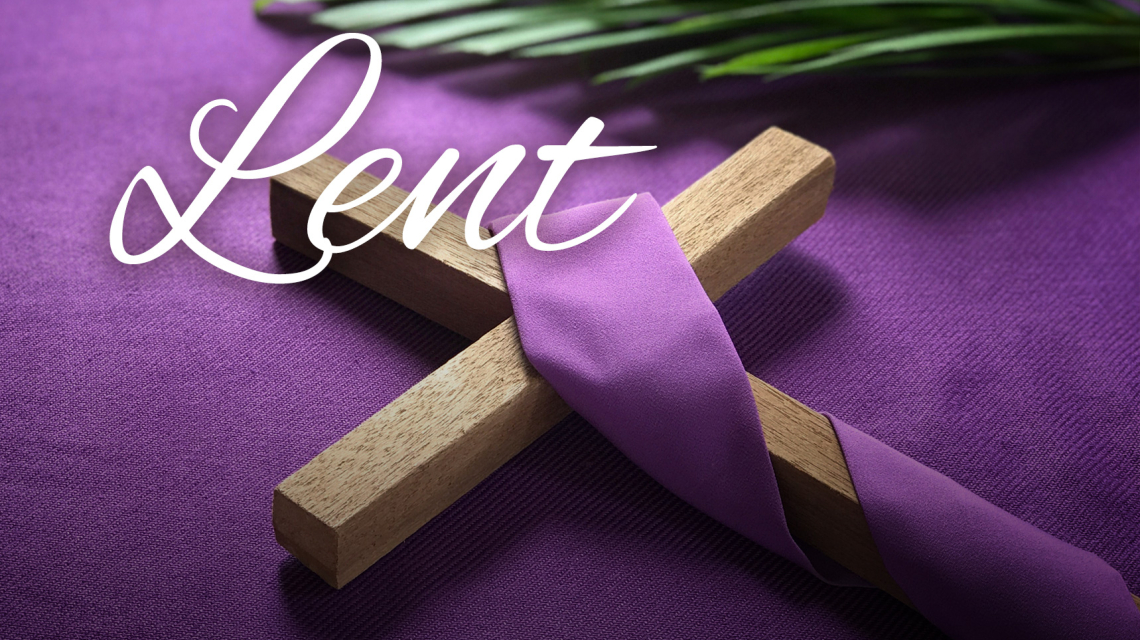
Once again, the Lenten season is upon us; however, there seems to be a tremendous amount of confusion about Lent; I shall (briefly) try to rectify:
It is true that Lent was NOT practiced by Jesus or the Apostles and in 1st century Palestine; however, that does not mean it has uncommonness. If you’re going to use the Bible as your defense, let us explore how accurate that is.
1: Since the earliest times of the Church, there is evidence of some kind of Lenten preparation for Easter. For instance, St. Irenaeus (d. 203) wrote to Pope St. Victor I, commenting on the celebration of Easter and the differences between practices in the East and the West: “The dispute is not only about the day, but also about the actual character of the fast. Some think that they ought to fast for one day, some for two, others for still more; some make their ‘day’ last 40 hours on end. Such variation in the observance did not originate in our own day, but very much earlier, in the time of our forefathers” (Eusebius, History of the Church, V, 24). When Rufinus translated this passage from Greek into Latin, the punctuation made between “40” and “hours” made the meaning appear to be “40 days, twenty-four hours a day.” The importance of the passage, nevertheless, remains that since the time of “our forefathers” — always an expression for the apostles — a 40-day period of Lenten preparation existed. However, the actual practices and duration of Lent were still not homogenous throughout the Church. (Like the Bible, it took a FEW centuries to develop; the canonization of the New Testament as we know it today took several HUNDRED years to possess its final form!)
2: Lent becomes more regularized after the legalization of Christianity in A.D. 313. by emperor Constantine. St. Cyril of Alexandria (d. 444) in his series of “Festal Letters” also noted the practices and duration of Lent, emphasizing the 40-day period of fasting. Finally, Pope St. Leo (d. 461) preached that the faithful must “fulfill with their fasts the Apostolic institution of the 40 days,” again noting the ‘apostolic’ origins of Lent. One can safely conclude that by the end of the fourth century, the 40-day period of Easter preparation known as Lent existed, and that prayer and fasting constituted its primary spiritual exercises. Of course, the number “40” has always had special spiritual significance regarding preparation. On Mount Sinai, preparing to receive the Ten Commandments, “Moses stayed there with the Lord for 40 days and 40 nights, without eating any food or drinking any water” (Ex 34:28). Elijah walked “40 days and 40 nights” to the mountain of the Lord, Mount Horeb (another name for Sinai) (I Kgs 19:8). “In the six hundredth year of Noah’s life, on the seventeenth day of the second month-on that day all the springs of the great deep burst forth, and the floodgates of the heavens were opened. And the rain fell on the earth forty days and forty nights” (Gen 7 11-12). Most importantly, Jesus fasted and prayed for “40 days and 40 nights” in the desert before He began His public ministry (Mt 4:2).
3: So why is Lent necessary? (I’M NOT ASSERTING IT IS MANDATORY.) After all, if we attend church each Sunday and read our bible daily, haven’t we reached our most “developed” communion with God? The short answer (in my view) is no. The pilgrimage of Lent (IT IS NOT A CELEBRATION LIKE MY PROTESTANT BRETHREN THINK) is necessary precisely because we do not always want or recognize His Kingdom. Indeed, rather than live in His communion and love, we have done nothing but forfeit that glory. We remain tied to our fallen world and our sinful state. We cling to our passions instead of clinging to God. Knowing this, the Church gives us Great Lent to assist us in our salvation. We need reminding. The Church is here to remind me of what I have abandoned and lost. And as she reminds me, I remember: “I have wickedly strayed from Thy fatherly glory” (Schmemann, Great Lent, 22). In order to continue to fully experience the joy of Pascha (Easter) and our participation in the Kingdom, we must journey through the Sinai wilderness of our sin. We must be made aware of our utter rebelliousness. In the EARLY days of Christianity, to gain new followers, the Lenten period was used as a recruitment tool; the candidate would fast, pray, go to mass/liturgy, and if thought a wise choice by elders of the church, would receive baptism at dawn on Easter morning; I cannot think of a better time to accept Christ and his teachings than on Easter morning! (This beautiful act of penance is long lost to our modern church prerequisites!)
4: Where is “The Bible” in all of this? It is not there. The Christian religion took centuries to develop; the canonization of the New Testament DID NOT begin until LONG after these “celebrations” were incorporated into the EARLY church. So, if “Sola Scriptura” is your only defense for NOT partaking in this beautiful journey, I have one question: What “Bible” are you speaking of? THE APOSTLES NEVER SEEN A BIBLE! BUT THEY DID ESTABLISH A CHURCH; the Latin Vulgate (translated by St.Jerome) came a few HUNDRED years later;Tyndale’s Bible,1,526 years later; the Geneva Bible,1,560 years later; the King James Bible,1,611 years later! So, if you don’t approve of the dates of the early “celebrations” of the Church, your scripture arrives (in its final form) much later, MUCH LATER! To close, Protestant, Eastern Orthodox and Roman Catholic all USE different Bibles. Consider the following differences; I can demonstrate hundreds more:
The Protestant Bible excludes the deuterocanonical books, which Protestants call the Apocrypha.
The Catholic Bible differs also from the Bible as recognized by churches of Eastern and Oriental Orthodoxy, which include books not accepted by the Catholic Church as canonical.
The Greek Orthodox Church generally considers Psalm 151 to be part of the Book of Psalms and accepts the “books of the Maccabees” as four in number, but generally places 4 Maccabees in an appendix, along with the Prayer of Manasseh. There are differences from Western usage in the naming of some books (see, for instance, Esdras Differences in names). The Greek Orthodox generally consider the Septuagint to be divinely inspired no less than the Hebrew text of the Old Testament books.
The Bible of the Tewahedo (Ethiopia) Churches differs from the Western and Greek Orthodox Bibles in the order, naming, and chapter/verse division of some of the books. The Ethiopian “narrow” biblical canon includes 81 books altogether: The 27 books of the New Testament; the Old Testament books found in the Septuagint (a Greek translation of the Old Testament from Hebrew) and that are accepted by the Eastern Orthodox (more numerous than the Catholic deuterocanonical books); and in addition Enoch, Jubilees, 1 Esdras, 2 Esdras, Rest of the Words of Baruch and 3 books of Meqabyan (Ethiopian books of Maccabees entirely different in content from the 4 Books of Maccabees of the Eastern Orthodox). A “broader” Ethiopian New Testament canon includes 4 books of “Sinodos” (church practices), 2 “Books of Covenant”, “Ethiopic Clement”, and “Ethiopic Didascalia” (Apostolic Church-Ordinances). This “broader” canon is sometimes said to include with the Old Testament an 8-part history of the Jews based on the writings of Titus Flavius Josephus, and known as “Pseudo-Josephus” or “Joseph ben Gurion” (Yosēf walda Koryon). ALL OF THESE TOOK CENTURIES OF EDITING, PROCESSING, COPYING, REVISION, TRANSLATION, etc! (This is just a fragment of how complicated the translation(s) and ACCEPTANCE of ‘The Bible(s)’ can be.) So, IT IS NOT WISE TO ATTEMPT TO CONVINCE SOMEONE SIMPLY BECAUSE THE BIBLE DOES NOT SAY SO.
In precis, am I implying that you need to fast to procure salvation? Absolutely not. To refer to the Protestant reformer John Calvin’s views on fasting, he explicitly opines the contrary: INSTITUTES IV.12.19 : “Another evil akin to this, and greatly to be avoided, is, to regard fasting as a meritorious work and species of divine worship. For seeing it is a thing which is in itself indifferent and has no importance except on account of those ends to which it ought to have respect, it is a most pernicious superstition to confound it with the works enjoined by God, and which are necessary in themselves without reference to anything else. Such was anciently the dream of the Manichees, in refuting whom Augustine clearly shows that fasting is to be estimated entirely by those ends which I have mentioned, and cannot be approved by God, unless in so far as it refers to them.”
In other words, God will not answer your prayer because you fasted a certain number of days but fasts allow us to focus our prayers! Great wisdom that I wish I had heard said before.
What is the purpose of fasting? Calvin gives three ends:
INSTITUTES IV.12.15 : A holy and lawful fast has three ends in view. We use it either to mortify and subdue the flesh, that it may not wanton, or to prepare the better for prayer and holy meditation; or to give evidence of humbling ourselves before God, when we would confess our guilt before him.
The first end is not very often regarded in public fasting, because all have not the same bodily constitution, nor the same state of health, and hence it is more applicable to private fasting.
The second end is common to both, for this preparation for prayer is requisite for the whole Church, as well as for each individual member.
The same thing may be said of the third. For it sometimes happens that God smites a nation with war or pestilence, or some kind of calamity. In this common chastisement it behaves the whole people to plead guilty and confess their guilt. Should the hand of the Lord strike anyone in private, then the same thing is to be done by himself alone, or by his family. The thing, indeed, is properly a feeling of the mind. But when the mind is affected as it ought, it cannot but give vent to itself in external manifestation, especially when it tends to the common edification, that all, by openly confessing their sin, may render praise to the divine justice, and by their example mutually encourage each other.
This all stated, there are extensive examples and scenes by Saint Paul himself in New Testament writings where he views fasting as a spiritual weapon. Example: 1 Corinthians 9:27. “No, I strike a blow to my body and make it my slave so that after I have preached to others, I myself will not be disqualified for the prize.”
While fasting is important, it is not the primary goal, it is an aide, but quite a useful one.
© 2026, Mark Grago. All rights reserved.