
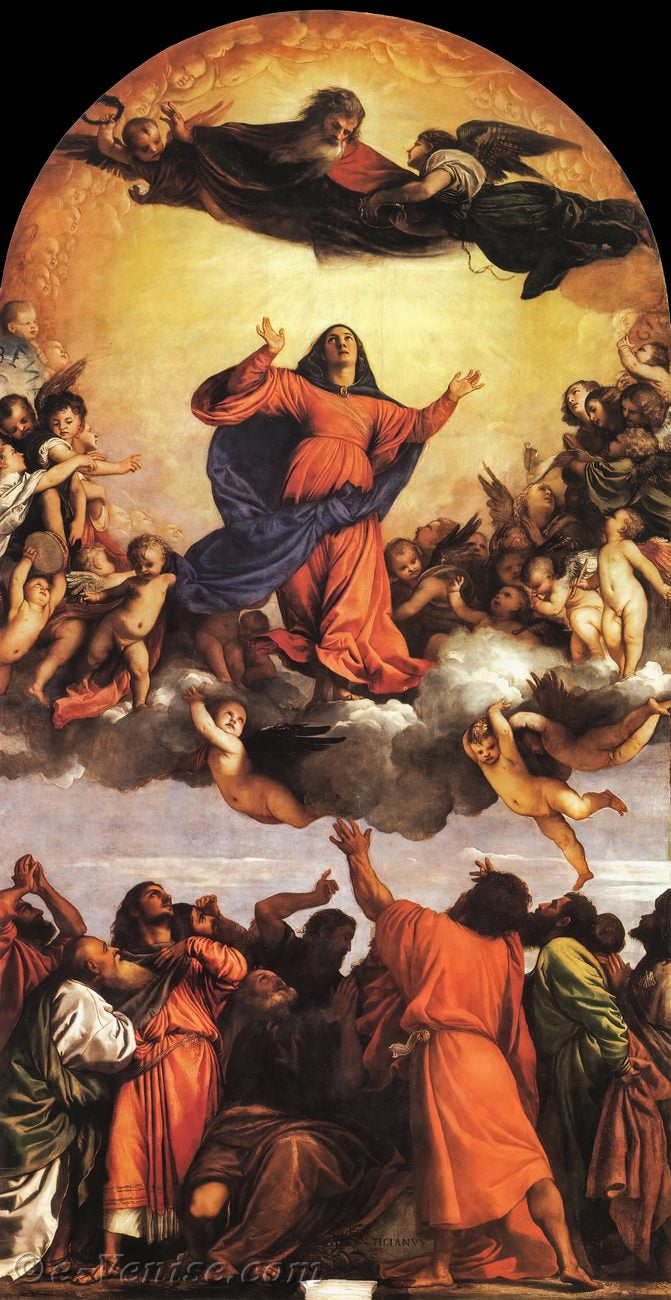
From the 16th century onward, the Assumption of Mary was not an article of faith until it was made so in 1950 by Pope Pius XII. It was, however, a quintal subject for artists; for Titian, it would inspire him to create one of his many masterpieces, this painting being a refulgent paradigm. The composition and complexion of the scene is broad and colorful; it is a waterfall of emotion and divinity. Below Mary are the apostles who are in awe of the scene being unfolded before them; it is though they are entranced by the Holy Spirit who has obviously influenced their motions and mobility.

The figures are represented by the three zones in the painting which are divided by spaces which seem to be only disunited from light, an eternal and bright light by God himself. Boldness and confidence shepherd the entire scene. In the zenith of the scene, the Blessed Virgin stands on clouds draped in a red robe and blue mantle. Around her are whorls of angels, protectors and guides for the Virgin upon entering her reward of eternal glory. They gaze, they praise, they embrace this divine moment of her entry into heaven; it is glorious and radiant; it is also the moment when she receives her crown from God the Father; she is now the Mother of Christ and Queen of Heaven and Earth. Her destiny is secured in immortality.
Titian separated himself in this painting with the traditional landscapes; however, he did fill a need in this composition to add a blue/grayish sky as to promote this being an outdoor act of providence.

Various interpretations of this painting continue to be enacted in debate and conversation. My own observation is one example. Saint Peter is certainly a part of this, and rightly so because he was Jesus’ favorite; he sits in the bottom center, clothed in awe, and his hands folded in prayer and his gaze towards Mary and heaven and God the Father himself. To the left of him would be none other than Saint John the Evangelist, the symbol of youth and power and perseverance. As for the others, except for Judas, is a matter that Titian, perhaps, left to the viewer to label and contemplate over.
Elegance, mystery, and victory are all on the pedestals of sacrifice and salvation for all. The oceans of light and radiance on the canvas grab the viewer and pull them into the plethora of the revelations of eternity and bliss. It is a subject that Titian has dutifully bequeathed to the believer and conveys a peculiar retraction to the doubter.
| Artist | Titian |
|---|---|
| Year | 1516-1518 |
| Medium | Oil on panel |
| Dimensions | 690 cm × 360 cm (270 in × 140 in) |
| Location |


© 2026, Mark Grago. All rights reserved.